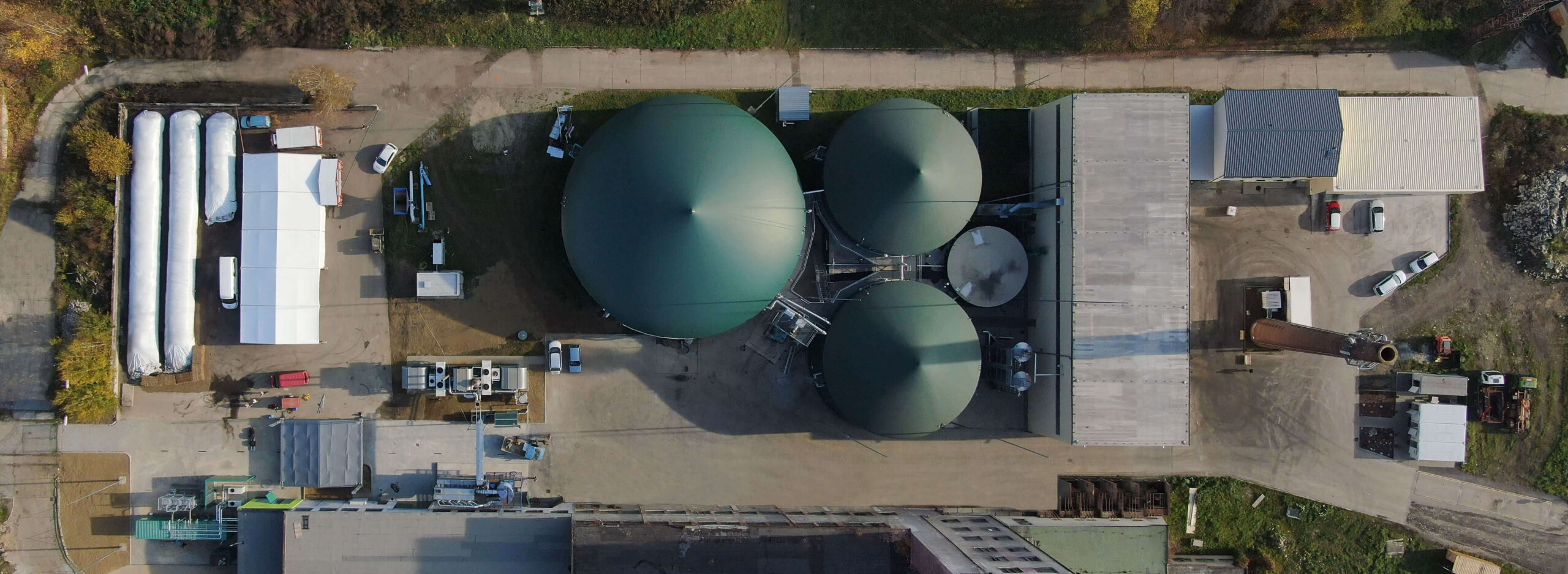
Thanks to the simultaneous efforts to divert bio-waste from landfills and to increase self-sufficiency in the production of gaseous fuels, BPS projects are being developed (to complement the activities of utility companies in cities such as Prague and Brno).
EFG Rapotín BPS
EFG Group, a member of the ČAObH, has been involved in BPS and biomethane for a long time. EFG Rapotín BPS was founded in 2012 to build one of the first waste biogas plants in the Czech Republic. The plant is already in its fifth year of operation and has a capacity to process 30,000 tonnes of waste per year.
It will potentially produce electricity and heat for about two thousand households. The entire facility has several sources of income. The first source is the disposal of the waste itself, followed by the sale of the commodities produced. In economic terms, EFG Rapotín BPS required an investment of more than CZK 280 million. The current market value of the project amounts to CZK 334 million.
EFG Green gas is a company within the EFG Group that focuses on the efficient recovery and use of biogas produced in biogas plants. We are primarily engaged in the upgrading of biogas to biomethane, its sale and distribution. The first project of EFG Green gas is the installation of a biomethane production unit in the biogas plant at EFG Rapotín BPS, which has increased the economic efficiency of biogas use by 30%.
Part of the service strategy is to achieve the required national CO2 savings, which EFG sees primarily in increasing the use of biomethane in transport and developing the market for this "green gas".
EFG produces electricity, heat and biomethane
EFG produces only green energy from biodegradable waste through anaerobic digestion. The heat is supplied to the central distribution system of Rapotín, the electricity and biomethane directly to the distribution system.
However, since 2020, a long-awaited change has been made, with the two categories of support being consolidated into a single AF category, at the level of the original AF1 category. Under these new rules, waste biogas plants have benefited and are now eligible for higher support. At the same time, agricultural biogas plants can now also accept biodegradable waste and continue to receive the support to which they are accustomed.
However, in order for an agricultural biogas plant to be able to accept bio-waste, it must be equipped with equipment that removes impurities from the waste and ensures its so-called hygienisation - heating the substrate to 70 °C and leaving it at this temperature for at least one hour. The resulting hygienised substrate becomes safe and can be processed in an agricultural biogas plant.
EFG Vyškov BPS
The plant operates in a continuous mesophilic mode (around 40 °C) and is permitted to process 30 000 tonnes of bio-waste per year, which corresponds to the production of approximately 5 000 000 Nm³ of biogas and 23 000 tonnes of organic-mineral fertiliser. As these products are used without residue, this is a plant with maximum use of the waste processed.
In addition to the material use of fertiliser, anaerobic digestion technology contributes to environmental protection in particular by not emitting methane, CO₂ and ammonia fumes into the air, which contribute to climate change, when disposing of bio-waste, unlike composting and landfilling.
These facts clearly place EFG at the very top of the bio-waste recovery technologies in the Czech Republic. This year, the green gas capacity is expected to reach 90 GWh/year. Emissions from the potential production of BRO 2 million tonnes - landfill gas production: 204 m3 CO2, 306 m3 CH4. EFG has about 45 thousand tonnes of BRO processing capacity, so in this proportion it diverts emissions and processes them into green energy.
What specific changes are ahead for EFG's existing energy facilities?
In 2023, the installation of a biomethane production unit at the biogas plant in Vyškov will be particularly important, as it is to be the next source of "green gas" in the Energy Financial Group's portfolio after EFG Rapotín BPS.
This will supplement the electrical and thermal energy currently produced from biogas. For this purpose, among other things, the waste processing capacity will be increased from the current 12 to 30 thousand tonnes of biodegradable waste.
Miloš Kužvart,
Executive Director of the Czech Association of Circular Economy, z.s.